
“I’m not supposed to be here is what they had me believing / had me thinking that the best choice for me was leaving. / Realized that I had a drive to exercise my right, / I will not leave, in fact I’m back again for another fight.”
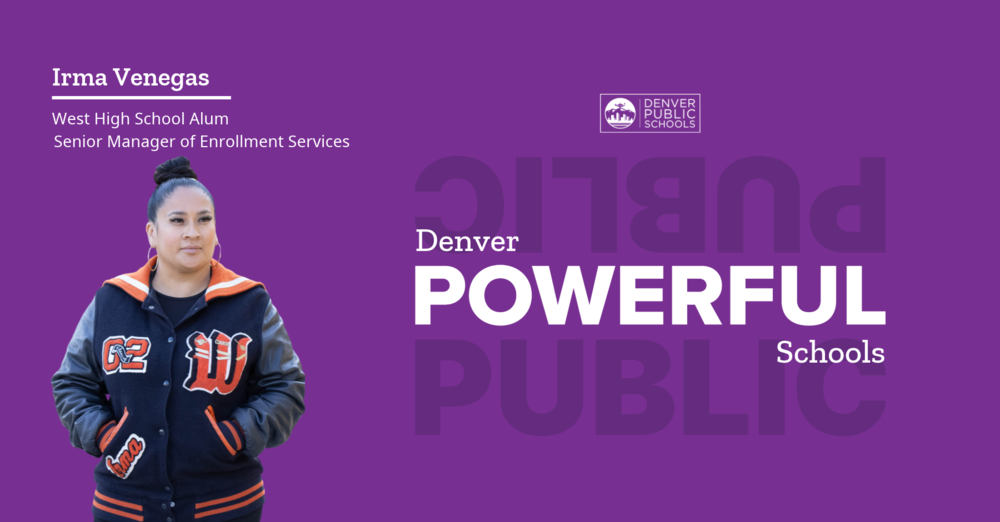
This is an excerpt from DPS alum Irma Venegas’s spoken word poem, “Chasing a Dream.” In it, Irma explores her identity as a Mexican girl growing up in America. Hardship and discrimination often made her feel powerless, but through art and education, she learned how to own her power.
Despite being a straight A student at West High School, when Irma first started college, she questioned if she even belonged there. Irma noticed that not only did her peers not look like her, but she came to realize that they had higher ACT scores than her and did not need to take any remedial classes as she did. She felt like she was always trying to catch up, and she was ashamed of that.
Her mindset slowly shifted from shame to pride as she built a community on campus. A major turning point was selecting her major, ethnic studies. Through her major, she connected with peers and met professors who became her mentors. She even started the Ethnic Studies Student Association on campus.
“I belong here. I deserve to be here,” Irma realized.
Through her ethnic studies classes, Irma learned the history of people of color in America – including her own Mexican American history. She learned that history depends on who is telling it, and that the negative narratives and stereotypes she grew up hearing were simply not true.
“Sometimes, we’re taught our history, but not in a positive way. That causes self-hate. I wish I didn’t have to wait until college to take pride in myself and my history and my people,” Irma shared.
The more she learned about her people’s history, the more Irma gained a sense of pride in who she was.
“The older I got, the more I read and the more I learned, the more I started to feel confident in the woman I was becoming. Education transformed my life,” Irma said.
Now, as Senior Manager of Enrollment Services, Irma helps students access the transformative power of education. She really believes in the DPS SchoolChoice process, which enables students to select a school that best fits their needs and goals.
“A key part of young people’s lives is their journey with education. I feel very grateful and honored to work for a department that provides opportunity and choice for young people. They are not boxed into a school that’s in their neighborhood, but they are given the freedom to choose otherwise. Families can choose what’s best for their children – what kind of school they want, what program they want,” Irma explained.
Irma doesn’t just do meaningful work – she does so with intentionality. She practices taking up space as a woman of color in a leadership role. Irma worked hard for her seat at the table and advocates for those who are not at the table. While she has come a long way, she is still learning.
“Even as an adult, I’m finding my voice. I’m a female Latina in a manager position. I’m learning to take up space in spaces where there’s not a lot of people who look like me,” Irma said.
Irma also draws on her education to give back to her community. Her goal is to shift the narrative about people of color like herself.
“At the end of the day, it’s about representation and the people you have access to. I really took ownership of being a role model to my community, to my nieces and nephews. I am a mentor and a coach to people of color, to really show them that anything is possible,” Irma said.
Irma believes that art can be a powerful tool for exploring and owning one’s identity. Her whole journey of stepping into her power started with writing a spoken word poem for her Higher Education Leadership master’s program at the University of San Diego.
“Spoken word holds expression and emotion. You can say something bluntly without feeling bad about it. Spoken word allowed me to be powerful, bold and confident. It allowed me to make a statement about who I was and what I’ve been through,” Irma said.
Irma wishes she had tried writing spoken word poetry sooner, as a high schooler at West or even as a middle schooler at DCIS Baker.
“Exploring your story and narrative at a young age matters,” Irma said.
Irma wants young people, especially those who may feel powerless like she did as a child, to explore who they are through art – whether it’s spoken word poetry or another medium like drawing, acting, or web design.
Irma hopes that students will start this exploration by talking to family — grandparents, parents, siblings — to learn their history.
“I encourage people to look at their past, to learn about their history and use that as a way to move forward in their life; to find their passion and engage with the rest of the world. Young people need to know who they are, in order to know where they are going,” Irma said.
Irma believes that understanding where you come from is key to owning your power.
“If you’re a person who knows your worth, knows where you come from; if you’ve acknowledged your ancestors and where you’re headed, then there’s no way that someone else can come and take that away from you. If you know who you are, no one can tell you who you are. You will sit in that power and be that change,” Irma said.
“I live in my power, and that’s a beautiful thing,” Irma added.